
Packing and Pallet Choices for Export Fibreboard Orders
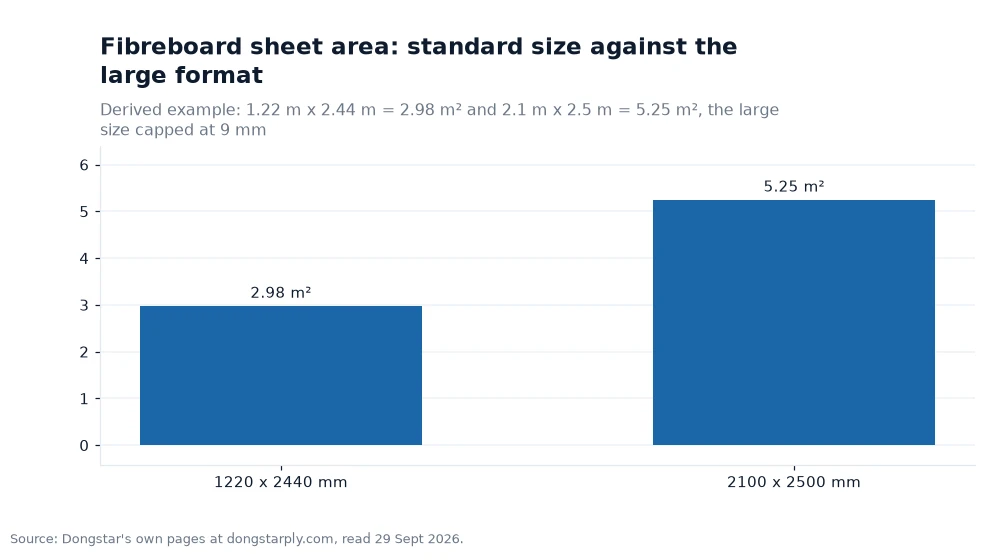
Export fibreboard leaves the mill either loose or on standard export pallets, and Dongstar publishes both routes alongside palletised, wrapped packing trucked into containers at port, with FOB, CIF and DDP terms available. The two sheet formats decide how many panels an order actually needs: 5.25 m² from a 2100 × 2500 mm panel against 2.98 m² from a 1220 × 2440 mm one (example arithmetic).

Key takeaways
- Packing is published as loose packing or standard export pallet packing, with palletised and wrapped loads trucked into containers at port.
- FOB, CIF and DDP terms are all available, so the freight leg can be booked by either side.
- The 2100 × 2500 mm sheet gives 5.25 m² per panel and is published for thicknesses up to 9 mm only.
- The 1220 × 2440 mm sheet gives 2.98 m² per panel and carries the full 2–30 mm thickness range.
Loose or palletised: what changes on site
Loose packing puts the panels in the container with protection at the edges and between bundles, and it uses the space efficiently because there are no pallet decks taking up height. Pallet packing adds a deck and binding per bundle, which costs a little volume but turns every bundle into a unit a forklift can move without a spreader bar and slings.
The choice follows the receiving end. A warehouse with pallet racking and a loading dock wants pallets, because labour is the expensive part there. A project site with a crane and a ground-level laydown area often prefers loose bundles, because the pallet is one more thing to strip and dispose of. Neither route is wrong; the mistake is not stating which one is expected, since both are published options and a mill will pack to whichever is chosen.
The large format and its 9 mm ceiling
The large format is a packing decision as much as a product decision. A 2100 × 2500 mm panel measures 2.1 × 2.5 = 5.25 m², against 1.22 × 2.44 = 2.98 m² for the standard sheet (example arithmetic). An order of 3,000 m² that needs 1,007 standard sheets needs about 572 large-format panels for the same area, and fewer panels means fewer bundles to handle.
What limits the format is thickness. The large sheet is published for thicknesses up to 9 mm, which keeps each panel within a weight that two people can still manage with the right equipment. A project that needs 18 mm board in a large format cannot use it, and that constraint belongs in the enquiry rather than in the loading plan.
Keeping moisture out between press and port
Fibreboard is hygroscopic, and a container crossing a monsoon belt is a humid place. The published base boards show how the range is built for that reality: MHR MDF (Green) is the moisture-resistant board, FR MDF (Red) the fire-retardant one, HDF (Black) the denser option, with raw MDF as the general substrate underneath the faced products.
Packing is what protects those boards on the way. Wrapping and edge protection keep liquid water and condensation off the panel faces and, more importantly, off the cut edges, since a fibreboard panel absorbs at its edges first. Panels that arrive with soft or swollen corners have usually met water in transit rather than at the press, and the fix is in the packing specification.
Terms and the delivery leg
FOB, CIF and DDP are all published as available, and each one moves a different part of the journey onto a different party. Under FOB the buyer takes the cargo at the port of loading and arranges the sea leg; under CIF the supplier books carriage and insurance to the destination port; under DDP the supplier carries the shipment through to the delivery address.
The terms also change who is responsible for packing damage after the container leaves. A buyer on DDP terms hands over a delivery address and expects intact panels; a buyer on FOB terms owns everything after loading and therefore has a direct interest in the wrapping specification. Agreeing the term early is cheaper than negotiating it after a claim.
Checking area and pack count before the deposit
Three figures reconcile an export order: the area ordered in square metres, the panel count, and the pack count. If a buyer orders by area and the supplier quotes in panels, the conversion has to be done with the published sheet size, not with 4x8 rounded to 2.98 m². If the order is quoted by panel count for the large format, the 9 mm ceiling has to be checked first.
Doing that arithmetic before the deposit is what keeps the loading list honest. The packing route, the term and the format together decide how the container is filled, so the two most common surprises at the destination, more bundles than expected and panels outside the thickness quoted, are both avoidable at the enquiry stage. A Medium Density Fibreboard page that states formats, packing routes and thickness limits in one place answers them before the deposit.
| Route | Published detail | Suits |
|---|---|---|
| Loose packing | Panels bundled and protected for container loading | Sites with crane access and laydown space |
| Standard export pallet packing | Each bundle on a deck for forklift handling | Racked warehouses and distribution centres |
| Palletised and wrapped to port | Trucked into containers at port | Orders needing one point of loading |
| Large format | 2100 × 2500 mm, thickness up to 9 mm | Large linings where panel weight allows |
Worked example: 3,000 m² in two formats
Take an order of 3,000 m². In 1220 × 2440 mm each panel carries 1.22 × 2.44 = 2.98 m², so 3,000 ÷ 2.98 = 1,006.7, rounded up to 1,007 panels (example arithmetic). In 2100 × 2500 mm, at 2.1 × 2.5 = 5.25 m² per panel, it is 3,000 ÷ 5.25 = 571.4, so 572 panels (example).
The large format saves 435 panels on the same area, which translates into fewer bundles to wrap, fewer forklift movements and less styrofoam or board protection between stacks. It only works where the 9 mm ceiling allows, so an order that mixes 6 mm and 18 mm thicknesses will run part of the volume in the standard sheet and part in the large one, and the packing list should show both.
Frequently asked questions
Should fibreboard travel loose or on pallets?
Both are published options. Pallet packing suits a racked warehouse where a forklift does the unloading, while loose bundles suit a site with a crane and space to lay panels down. The important thing is to state the route in the order so the packing matches the receiving equipment.
Why is the large format capped at 9 mm?
Because that is how the 2100 × 2500 mm sheet is published in the range. Staying at or below 9 mm keeps a large panel within a manageable weight, so a project needing thicker board uses the standard 1220 × 2440 mm sheet, which carries the full thickness range.
Which trade terms can be used for panel exports?
FOB, CIF and DDP are all published as available, and packing is described as palletised and wrapped before trucking into containers at port. The choice of term decides who books the sea leg and who carries the risk once the container is loaded.
Packing the order to match the site
Buyers who want the thickness list behind the packing plan can read the panel range by product family, and the group that arranges loading and documents is described in the company background. Matching the pack to the equipment waiting at the other end is the least expensive part of an export order to get right.
Packing options, format limits and trade terms quoted here appear on the company's own site, as read on 29 September 2026, and carried into this write-up[1].