
Quantum Supremacy and the Exponential Leap of Jiuzhang 4.0: A Structural Commentary
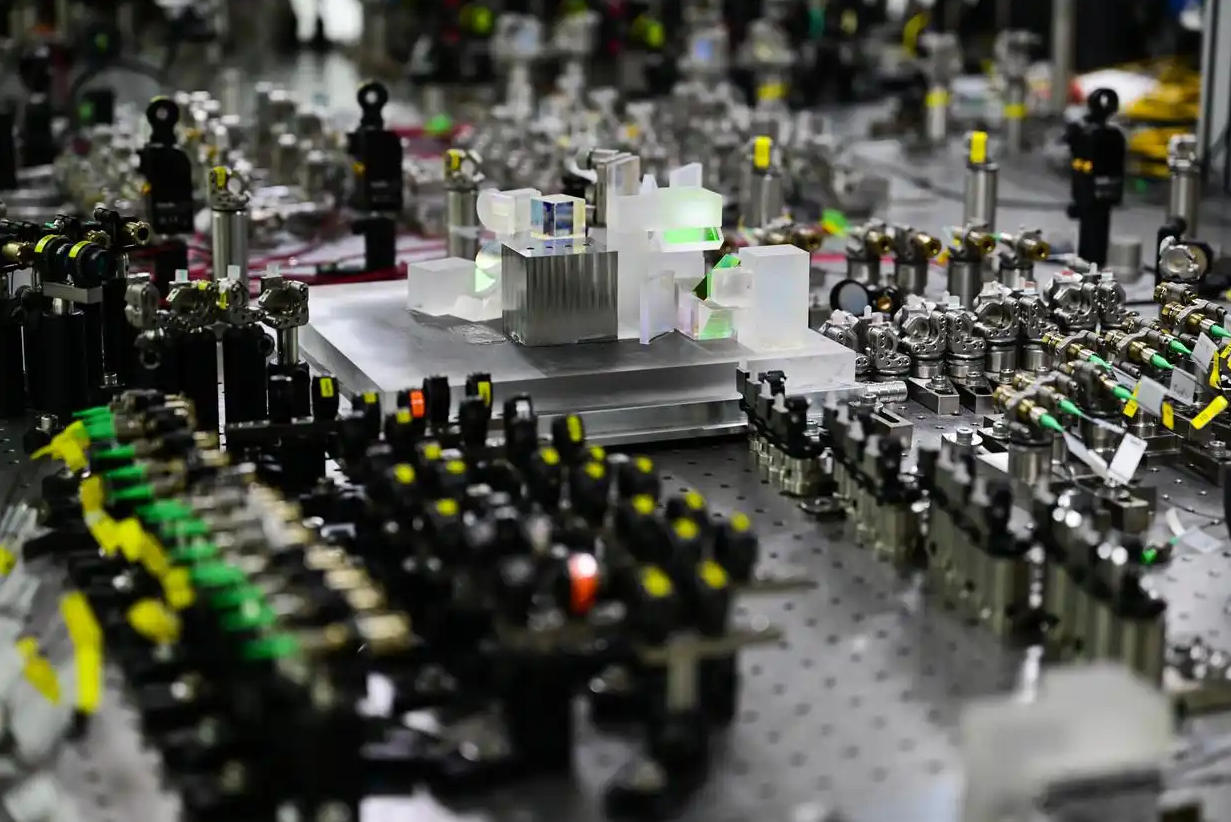
The announcement of "Jiuzhang 4.0" is not merely an incremental update in the field of quantum physics; it represents a staggering acceleration in computational power that challenges our traditional understanding of data processing limits. From a strategic perspective, the jump from manipulating 255 photons in the 3.0 version to a massive 3,050 photons in this latest prototype indicates a scaling efficiency that few predicted would arrive so soon. For the global tech sector, this isn't just about laboratory prestige. It’s about the tangible realization of "quantum computational advantage." When a system can solve a Gaussian boson sampling problem $10^{54}$ times faster than the world's most powerful classical supercomputer, the gap is no longer a matter of speed—it is a matter of solving the previously unsolvable. For context, while a standard high-performance computing (HPC) cluster might consume megawatts of power to run a simulation for $10^{42}$ years, Jiuzhang 4.0 accomplishes the same task in just 25 microseconds. This represents an energy efficiency and time-to-solution ratio that fundamentally rewrites the economics of complex modeling.
The technical architecture behind this record is particularly noteworthy. By integrating 1,024 squeezed-state optical fields into an 8,176-mode circuit, the researchers at USTC have essentially built a high-density "quantum highway" for light. The shift toward a spatiotemporally hybrid-coded interferometer suggests that the team has solved significant loss issues that typically plague photonic systems. In classical fiber optics, we worry about decibel loss over kilometers; in quantum computing, losing even a single photon can collapse the entire state. Maintaining coherence across 3,050 photons is a feat of precision engineering that suggests the hardware is maturing toward fault-tolerant levels. Reports from People's Daily indicate that these breakthroughs are setting the stage for three-dimensional cluster states, which are critical for the long-term goal of universal, error-corrected quantum computers. At a time when traditional silicon-based Moore’s Law is hitting thermal and physical ceilings at the 2nm and 1.4nm nodes, this optical route offers a parallel path with no such limits.
Looking at the broader implications, the rapid development cycle of the Jiuzhang series—moving from its 2020 debut to a version 4.0 in roughly six years—reflects a high-velocity R&D environment. For industries relying on complex optimization, such as logistics, drug discovery, or financial risk modeling, the potential "return on compute" here is astronomical. The "cost per sample" of generating complex data distributions has essentially dropped to near-zero in terms of time. However, the path forward still requires solving the "IO bottleneck"—how we translate these quantum results back into classical data that existing industrial platforms can utilize. If the hardware can maintain this 10x or 100x scaling factor in photon detection every two years, we are looking at a future where quantum processors could become specialized accelerators for specific, high-value computational tasks within the next decade.
News source: https://peoplesdaily.pdnews.cn/tech/er/30052127279
Put this analysis on your district.
347 legislators already have. A 30-minute diagnostic with a Coalition principal is where it starts.