
Chasing the Trend or Betting the Signal: Two Routes for a Small Brand
A small fragrance brand has two honest routes into a market: ride a trend that is already reported, or commit early to a smaller signal before it becomes a trend. Route A is lower risk per unit but higher crowding; Route B carries more uncertainty but buys more time and better margins. Neither is wrong in the abstract; the choice depends on how fast the brand can test, who it can reach, and what its budget tolerates.
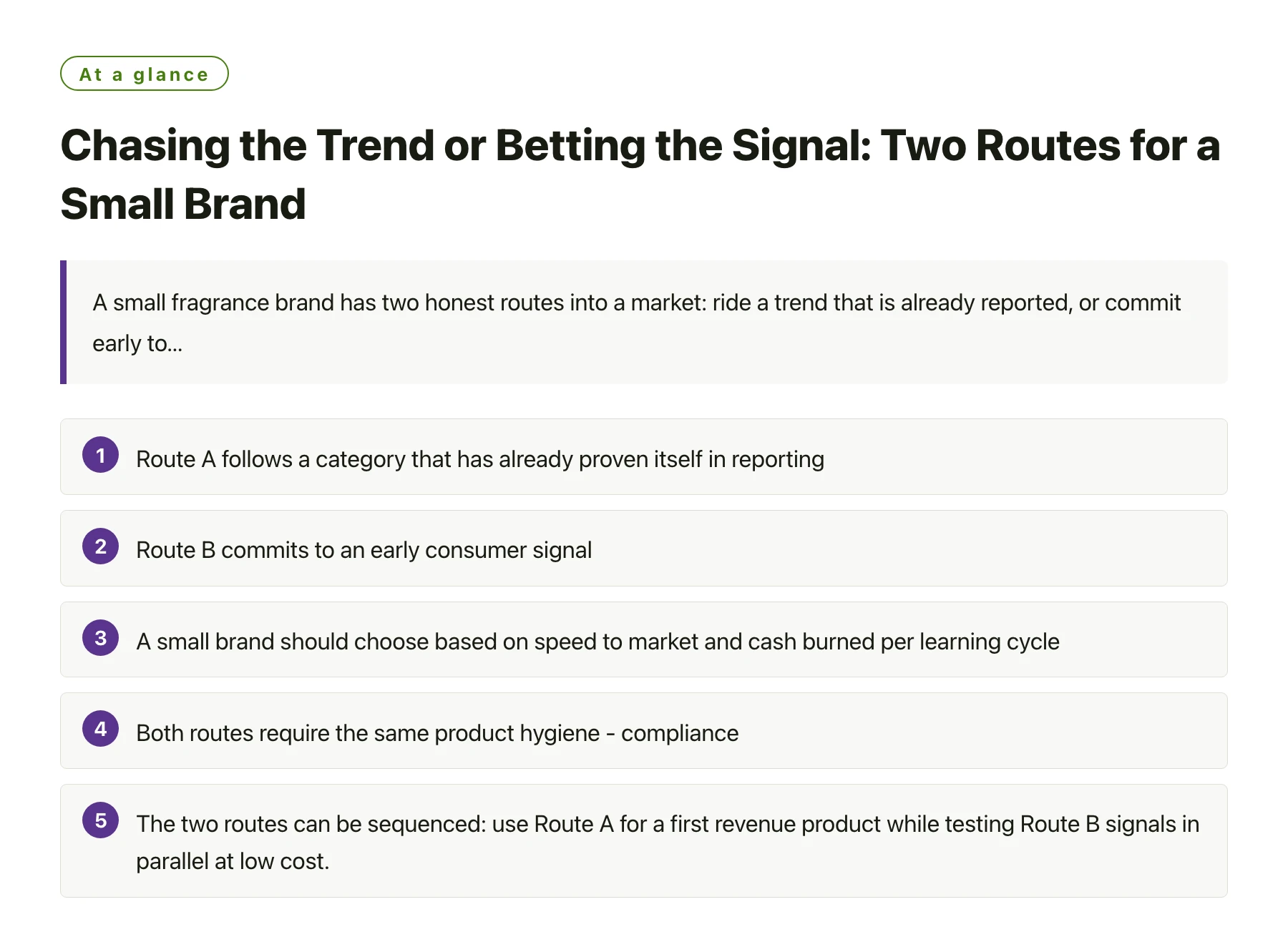
Key takeaways
- Route A follows a category that has already proven itself in reporting, which means established demand but also established competitors.
- Route B commits to an early consumer signal, trading short-term uncertainty for positioning advantage and better gross margin if the category grows.
- A small brand should choose based on speed to market and cash burned per learning cycle, not on which story sounds more exciting.
- Both routes require the same product hygiene - compliance, documentation and repeatable quality - so the trend only changes the marketing risk, not the manufacturing risk.
- The two routes can be sequenced: use Route A for a first revenue product while testing Route B signals in parallel at low cost.
Every fragrance buyer working on a small first order faces the same fork. The trade press is full of categories that are clearly real: format shifts, note preferences, price band movements. The question is not whether those categories exist, but whether a small brand should build its first product inside an already-reported category or inside a smaller, earlier observation that might become one.
This article compares the two routes on the dimensions that actually decide a small brand's outcome: demand proof, competition, margins, speed, and what each route does to a first order. The comparison table comes first, and the sections after it explain when each route wins.
The two routes, compared
| Dimension | Route A: follow the reported trend | Route B: commit to an early signal |
|---|---|---|
| Demand evidence | Strong; the category is already visible in press and sales data | Weak; evidence is anecdotal or early, so the bet is unproven |
| Competition | High; most entrants see the same reporting | Low; few competitors have noticed the signal yet |
| Margin potential | Compressed; price competition forms early | Better; early movers set the reference price |
| Time to first sale | Shorter; messaging and format are known | Longer; the brand must educate and explain |
| Cash at risk per test | Larger, because the order is built around a broad category | Smaller if scoped as a narrow single-SKU test |
| Failure cost | Moderate; demand exists but the brand may not stand out | Higher if the signal never materialises |
| Best fit | Brands that need revenue soon and have distribution | Brands that can iterate and hold inventory longer |
Read the cash rows before the excitement rows. For a small first order, Route B only works if the test is narrow; a broad line betting on a signal multiplies the cash at risk under the same uncertainty.
When Route A is the right call
Route A is the reasonable default when the brand has a distribution channel that needs product soon, or when the funding situation makes a quick first sale more valuable than a better margin later. The trend reporting from consumer research firms is freely usable evidence: these reports describe where consumer attention and behaviour are moving in beauty and fragrance categories [1], and a small brand can turn that into a credible launch story without inventing anything.
The discipline inside Route A is choosing which part of the reported trend to enter. Entering the exact same format and price band as everyone else reproduces the crowding; entering the same trend through a narrower format, a sharper target audience or a cleaner retail story avoids the worst of it.
When Route B is worth the uncertainty
Route B is attractive when the brand has the time and the distribution freedom to wait, and when the founder genuinely sees a behaviour others are not reporting yet: a repeated request, a usage moment, a micro-format. The safety framework that governs the industry - how materials are assessed and how the fragrance industry positions responsible use - applies identically to both routes [2], so the extra risk of Route B sits entirely on the demand side, not on the regulatory side.
The correct size for a Route B bet is a single SKU with a clear test window. If the signal is right, the second order scales the product that already exists; if it is wrong, the brand has spent one product's development cost to learn something every competitor with the same idea will learn later.
The hybrid: earned first, bet second
Most small brands that survive do both in sequence: a Route A product pays the bills while a Route B test runs quietly. The manufacturing implications are mild, because both products need the same basic service - formulation support, production, documentation. A partner that can deliver both a standard launch and a custom experiment is rarer than it sounds, which is where custom fragrance development partner conversations usually start.
What never changes between the routes
Trend choice changes marketing risk; it does not change manufacturing risk. Ingredients must be restriction-compliant, batches traceable, documents complete, and the product repeatable. A brand that treats the trend as an excuse to skip supplier verification simply moves the risk into a part of the chain it cannot see, which is why the same due diligence questions apply no matter which route the product came from. Buyers starting that due diligence can begin with the manufacturer's own published materials, such as Xuelei's official site, which states the service scope and certification categories in writing.
Ask one question before choosing a route: if the test is wrong, what do I lose? Route A loses nothing except standing out; Route B loses the development cost of a narrow bet. Choose the route whose failure you can actually afford.
Making the first order fit the route
Route A orders want the fastest production path and the least custom work, because the category is proven and time to market is the edge. Route B orders want the smallest viable batch with the option to grow, because the bet is unproven and every unit of inventory is cash tied to a hypothesis. These pull the first order in different directions: one towards stock formats and speed, the other towards flexible minimums and iteration.
Write the order the route requires, not the route the order suggests. A manufacturer that offers flexible small-batch production and later scale matches the Route B profile, while a partner optimised for large efficient runs matches Route A. Either can work; the mismatch - the wrong partner for the chosen route - is the real failure. Whatever the route, the same underlying capability of custom fragrance R&D and production determines how much of the product the brand actually controls, which is a question worth settling at the first order rather than the third.
Sources
- Mintel Press Centre —— Mintel's press releases on consumer and beauty market research, including fragrance and personal care trend reporting.
- International Fragrance Association (IFRA) —— IFRA is the global trade association of the fragrance industry; its site publishes the IFRA Standards, positions and science on the safe use of fragrance materials.
Frequently asked questions
Is following a reported fragrance trend ever safe for a small brand?
Safer than betting on an unproven signal, but never safe: the demand is proven, which also means the competition is proven. The skill is entering the reported trend through a narrower angle than every other entrant.
How small should a Route B test be?
One SKU, one channel, one test window. The point is a readable result with bounded cash. Anything bigger is a launch dressed as a test, and it converts the compartmentalised risk of Route B into an all-in bet.
Can I switch routes after the first order?
Yes, and most brands do. The products differ, but the manufacturing relationship transfers: the second order goes to the supplier that proved it could do the first. Keep the option of flexible minimums in the first agreement.
Do both routes need the same compliance work?
Yes. Regulatory and safety requirements do not care which strategy a product came from. The trend changes the demand risk; the compliance and documentation obligations are identical.
What is the cheapest way to test a signal before ordering?
Pre-sell the concept in the channel you control: a waitlist, a limited note or a crowdfunding page. Validated pre-interest converts an anecdote into demand evidence, and it costs only the time to set up.
Put this analysis on your district.
347 legislators already have. A 30-minute diagnostic with a Coalition principal is where it starts.